The five places
Today, Company, iO, Money, More.
For everyone, in the same order.
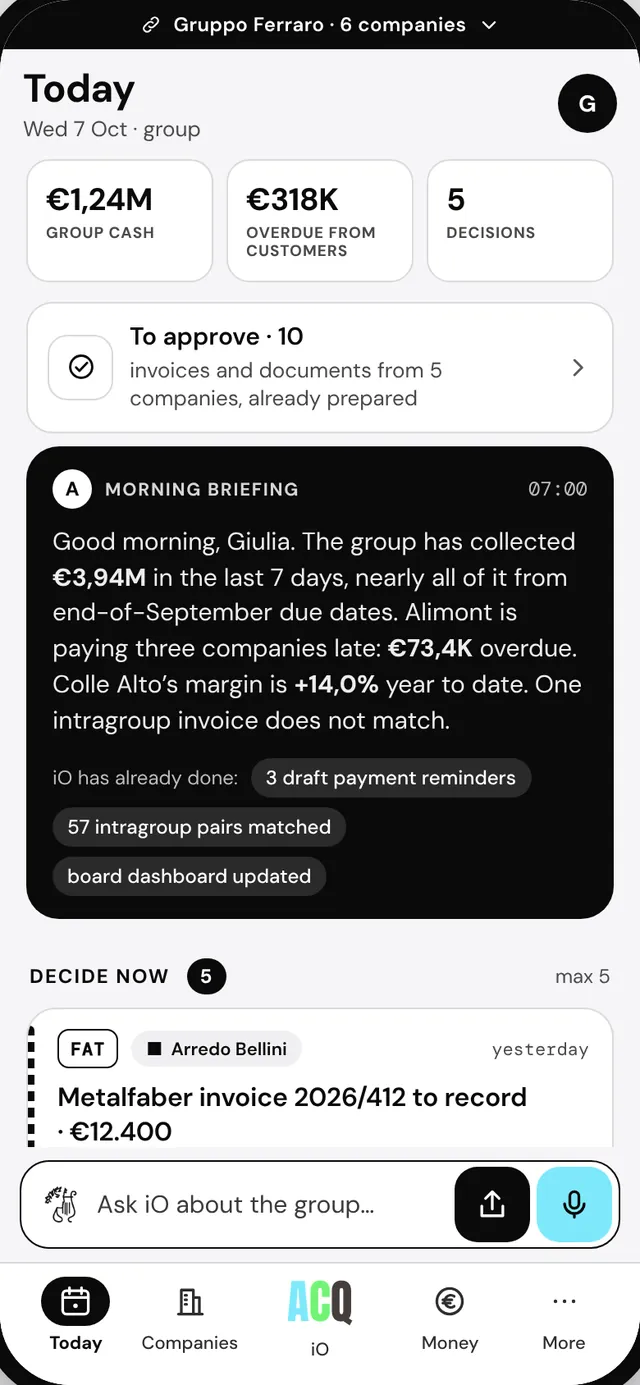
At the bottom there are always the same five words, from the owner to the newest hire, and no menu to scroll. Work lives in Today, Company and Money; iO is one tap from every screen; in More there is your profile, written plainly: what you see and what you don't, what you sign, what you let iO do on its own.
All the day's decisions, with the figures to decide; the ones you don't make today you can postpone to tomorrow. Below, “iO is monitoring”: lines that speak only when something changes. Today has an end: you reach the bottom and know there's nothing else.
Not a menu: a living map. Each room tells you a fact before you open it: “3 orders late, 1 awaiting material”. The owner finds every room; the worker, their own.
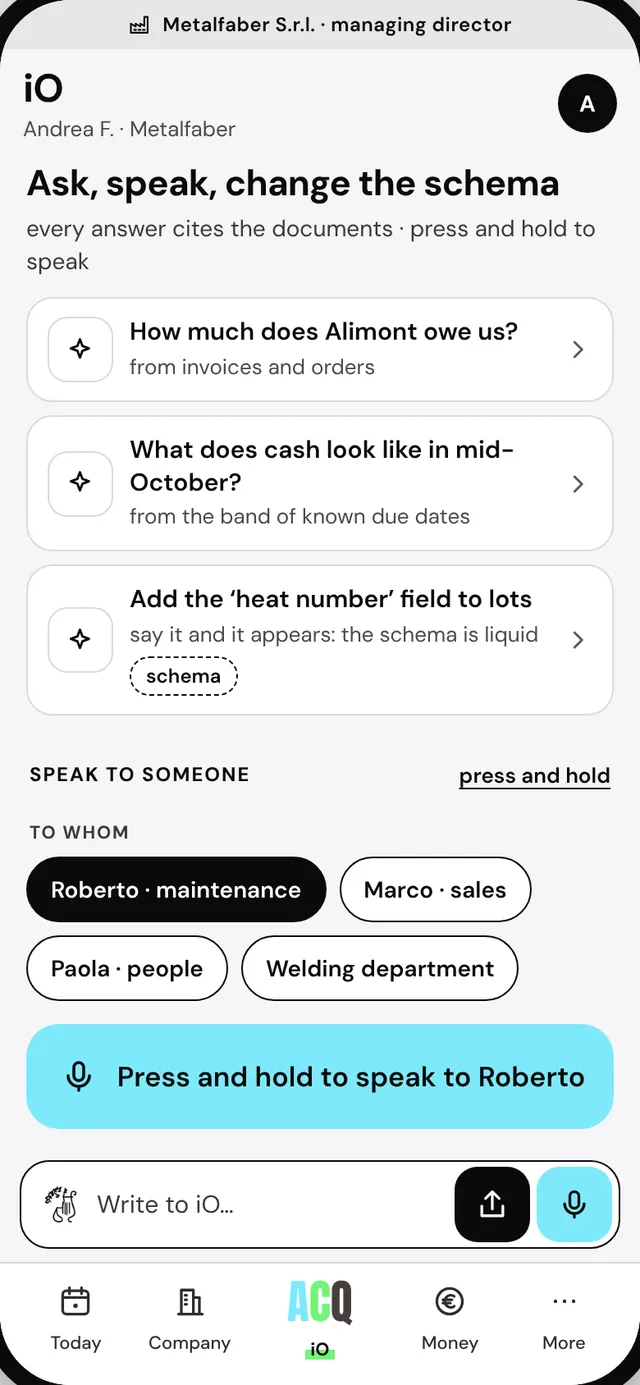
Tap and ask: the answer cites the documents it comes from. Press and hold to speak: to iO, or to a person, with the note linked to the thing you’re talking about. Say it and it appears: “add the heat number field to batches”, and the field is there.
For those who manage, today's cash and the cash expected over thirteen weeks, with an honest band instead of a line that's sure of itself. For those who do the work, “Mine”: hours, holiday, expense claims and payslips.
Your profile, line by line. Andrea sees all of Metalfaber but not the other companies in the group, signs offers and payments above €5,000, and has put expense claims under €50 on autopilot: iO approves them on its own, until he revokes it. And “Switch person”, if you have more than one.
How iO works
iO is on every screen.
Write, speak or upload, from wherever you are.
At the centre of the bar is its place, with ready questions and the people to talk to. But the “Ask iO” line sits on every screen, just above the bar: ask from wherever you are, without changing place. iO answers with its sources and proposes; you decide.
- Write
Every answer cites its documents.
“How much does Alimont owe us?” iO answers from the invoices and orders, and shows you which ones. If a figure is an estimate, it tells you.
- Speak
Press and hold to speak.
To iO, or to a person: Roberto in maintenance, the welding department. The note stays attached to the thing you're talking about: the batch, the order, the machine.
- Upload
A photo, and iO reads.
Photograph a delivery note, upload an invoice, a price list, a sketch: iO says what it read and what it inferred, and proposes where to file it. You confirm.
- On its own
iO works at night. You decide in the morning.
It records, matches, reconciles; by seven you find the briefing and the decisions ready. On its own it does only what you've entrusted to it: the autopilot, written in More and revocable.
Journey 1 · a business of five people
The owner does everything.
Her phone is the whole company.
Larkworth Pasta, five employees. No org chart, no approval flows: one person decides. Her iERP has nothing to configure: Today is her decisions, Company is every room, Money is the cash. The system took the shape of the business, not the other way round.
At night iO records, matches and reconciles. In the morning the owner finds seven decisions ready, not seventy lines to fill in: she approves, she doesn't enter data.
 7am briefing

No roles to set up.
A business of five people has an owner, not an org chart. iERP starts that way: one person, every room, and the lens is the company itself.
The work arrives already prepared.
Eighteen ledger entries, six bank movements, two delivery notes: done overnight. What’s left for the owner are the things that decide the margin: the reorder, the order to confirm, the late supplier.
It grows when you grow.
The day you hire a production manager, their lens is born from a sentence to iO. No reinstall, no module to buy: the same system, one more person.
Journey 2 · a business of thirty-eight people
The same five words.
Inside, each person’s own work.
Metalfaber, metalworking, thirty-eight people. Andrea is the managing director: his phone holds the whole company. Luca works on line 2: his holds line 2. Same app, same bar; what changes is the lens, that is, what reaches you.
Andrea F. · managing director
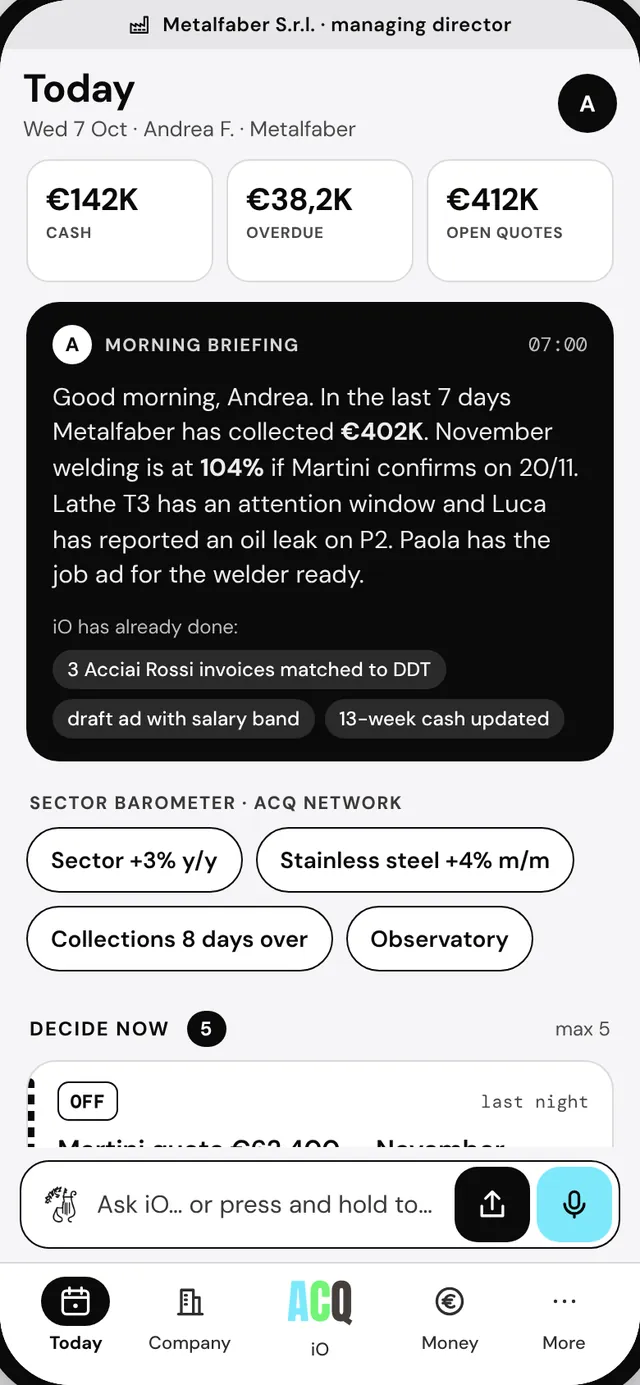
Five decisions, the cash, iO’s briefing
Seven rooms: shop floor, warehouse, people, Hub, Lab, shipments, jobs
Metalfaber’s cash, today and over thirteen weeks
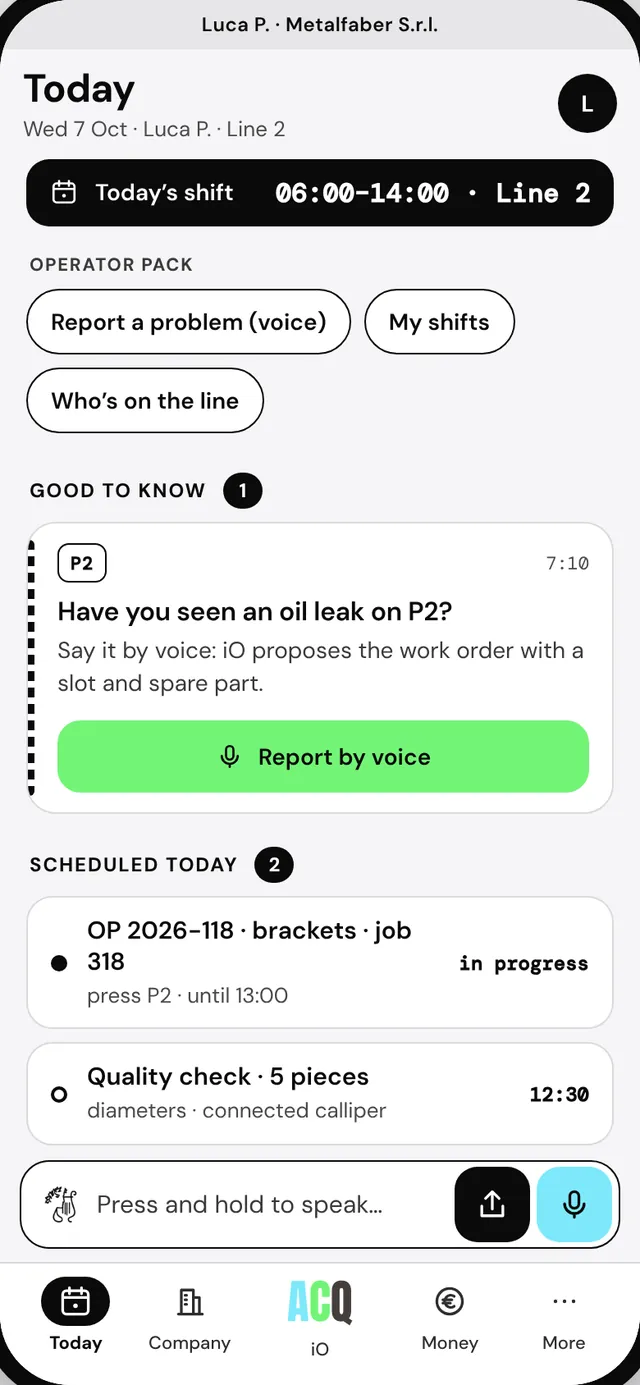
Luca P. · line 2 operator
The shift, the voice report, today’s jobs
Three: his line, his shifts, his path
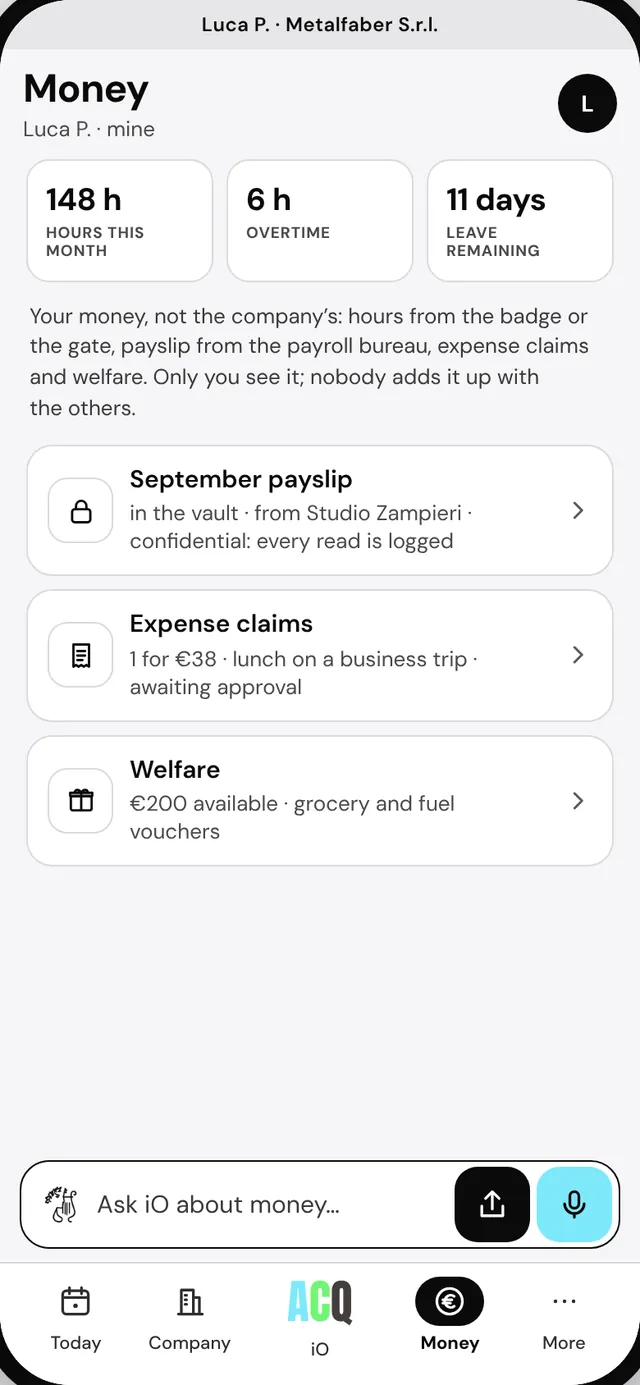
“Mine”: 148 hours, the payslip in the vault, one expense claim
From the clickable prototype, sample data. In More everyone can read what they see and what they don't: the lens isn't a permission hidden in a menu, it's written down.
Why does Luca have Money too?
Because that's where his pay arrives. Hours from the clock-in, overtime, holidays left, the payslip in the vault, a €38 expense claim, benefits. His money, not the company's: he sees it, and nobody adds it up with anyone else's.
That's the point of the whole design: every place means something to everyone. There's no employee portal next to the ERP, no app for the owner and another for the shop floor. There's one app, made to improve the lives of the people who work, not just to count their hours.
The reason is simple: the tiredness of a day is not just the work, it's everything that goes around it. Asking the office how many days off are left, waiting for the payslip to work out overtime, filling in a form for a breakdown, keeping a receipt to be reimbursed. Here each of these becomes an answer or a gesture, and the time it frees goes back to the craft and to home. And an app that helps the people who use it every day gets really used: that's how the company's data becomes real too.
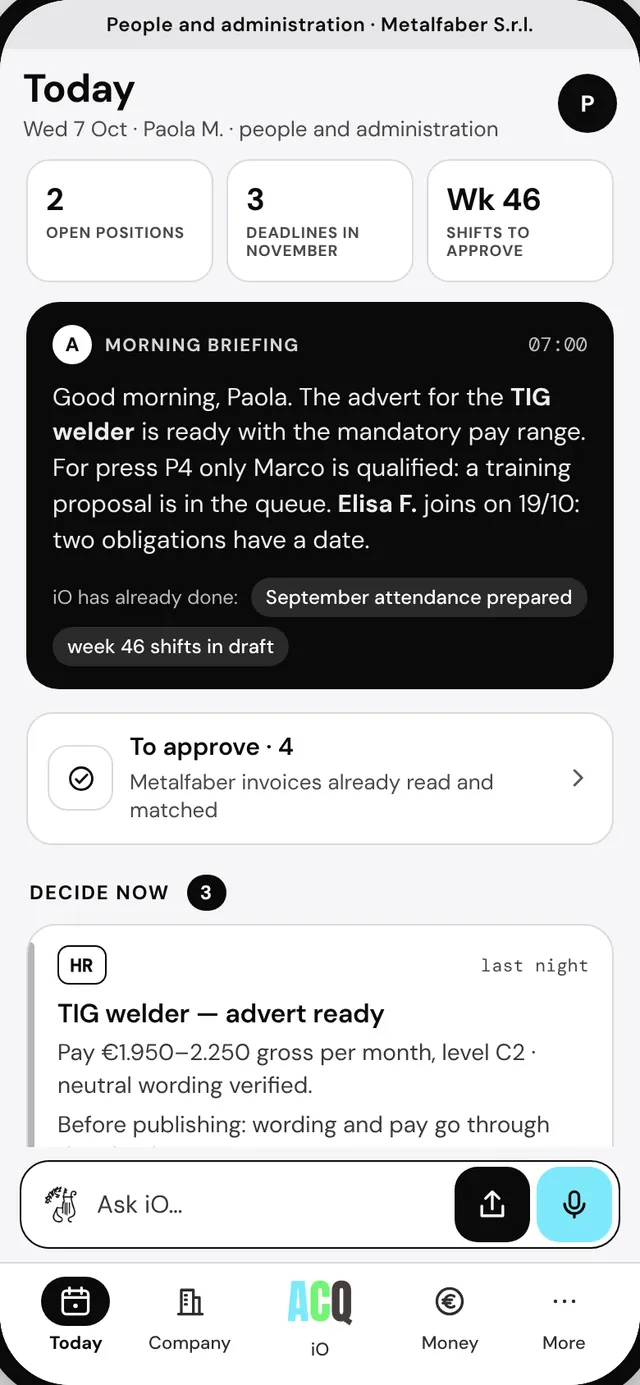
Paola M. · people and administrationThe job ad for the welder, the week 46 shifts, the invoices already matched.
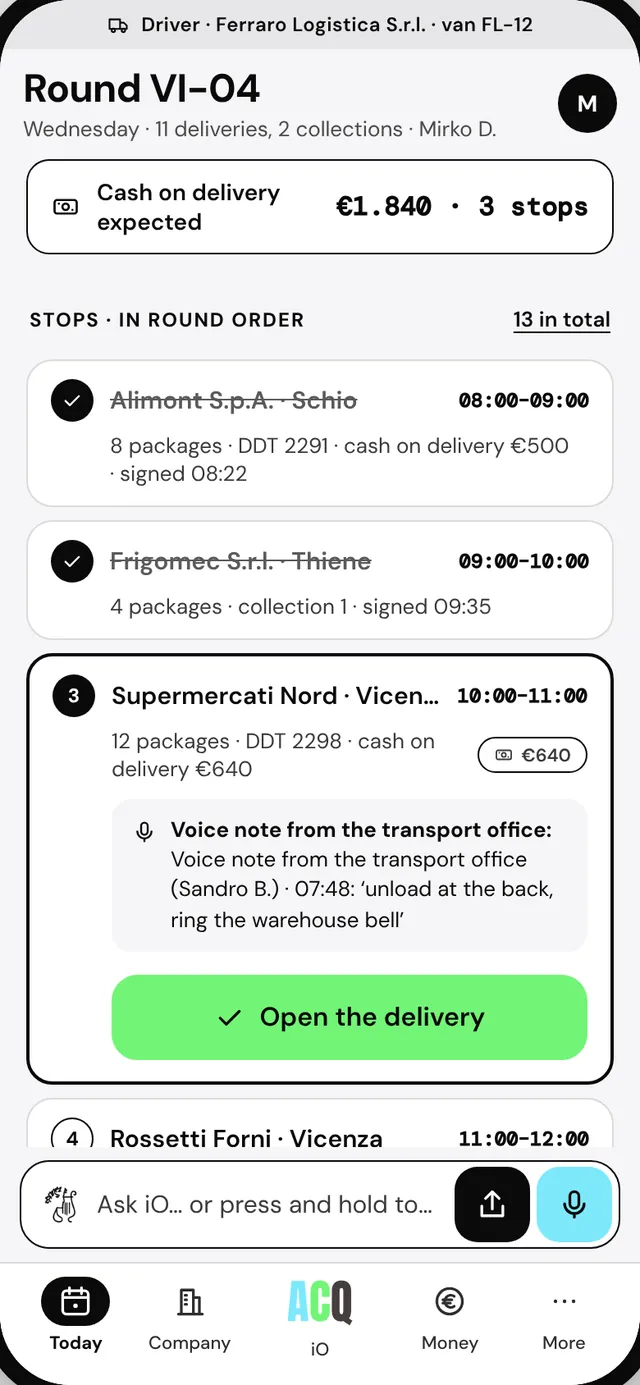
Mirko D. · driverRound VI-04 stop by stop, the cash on delivery to collect, the voice note from traffic.
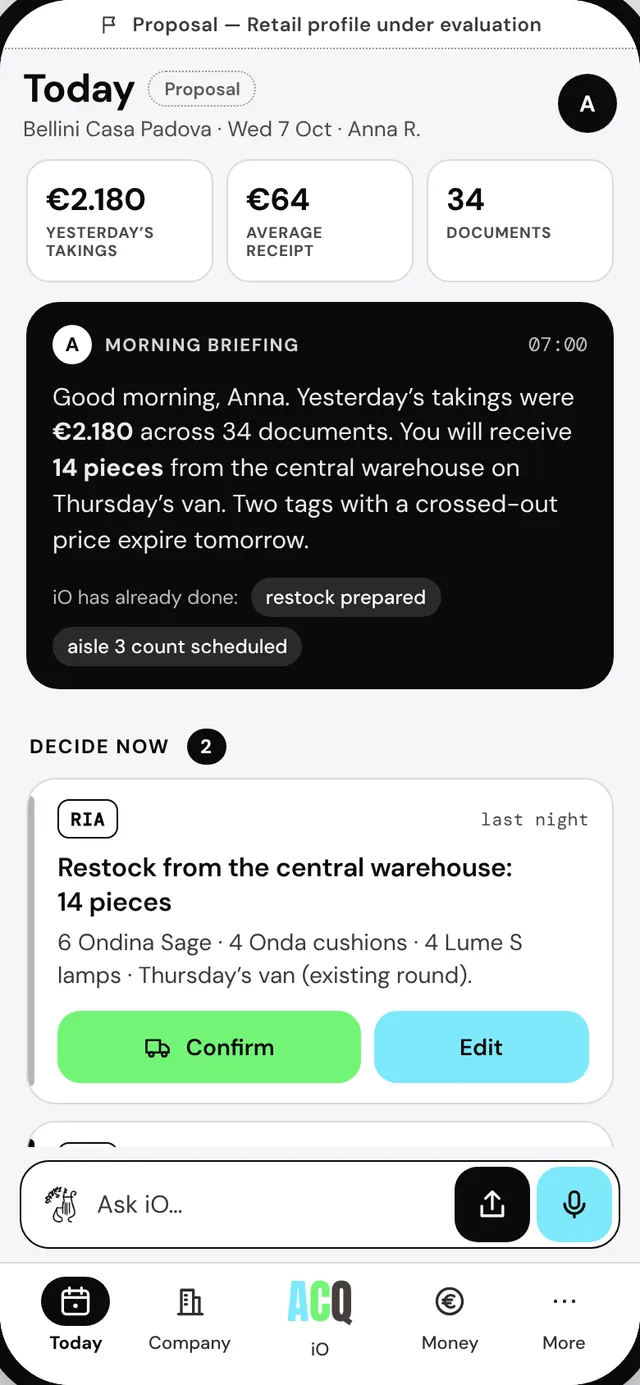
Anna R. · shopThe day’s takings, the average receipt, the restock from the central warehouse.
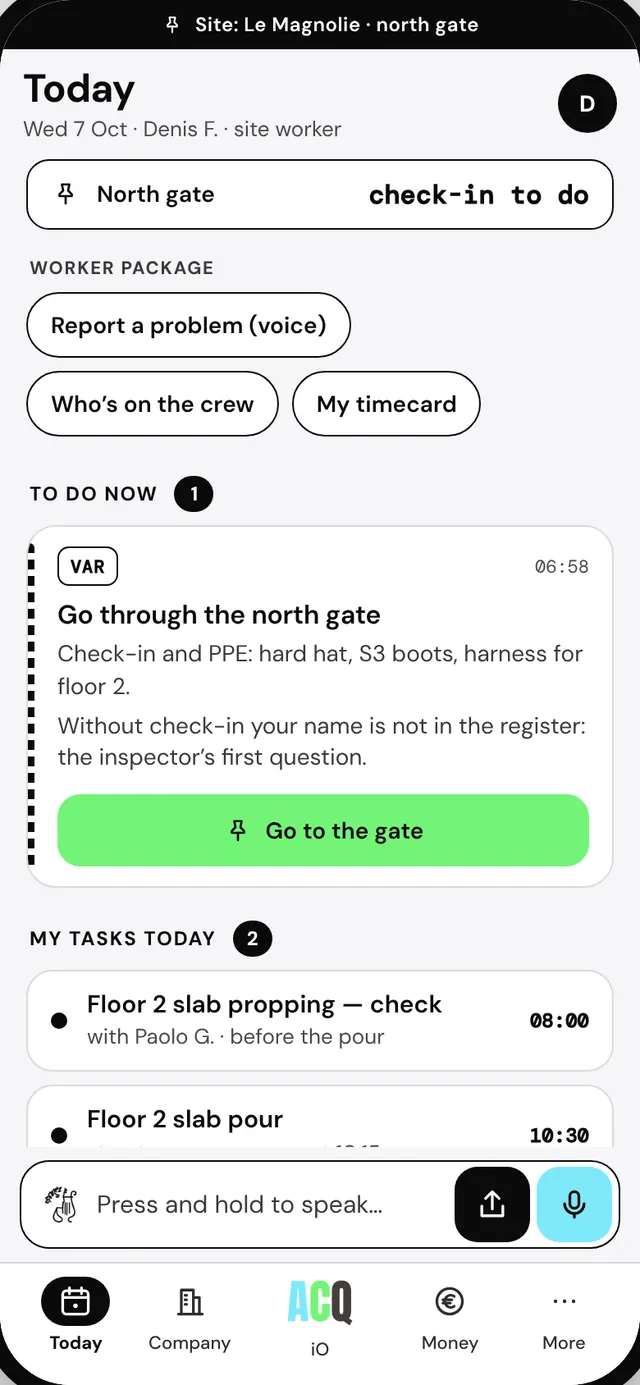
Denis F. · site workerThe gate with his PPE, today’s jobs, the crew. Costs and progress he doesn’t see: they’re not his job.
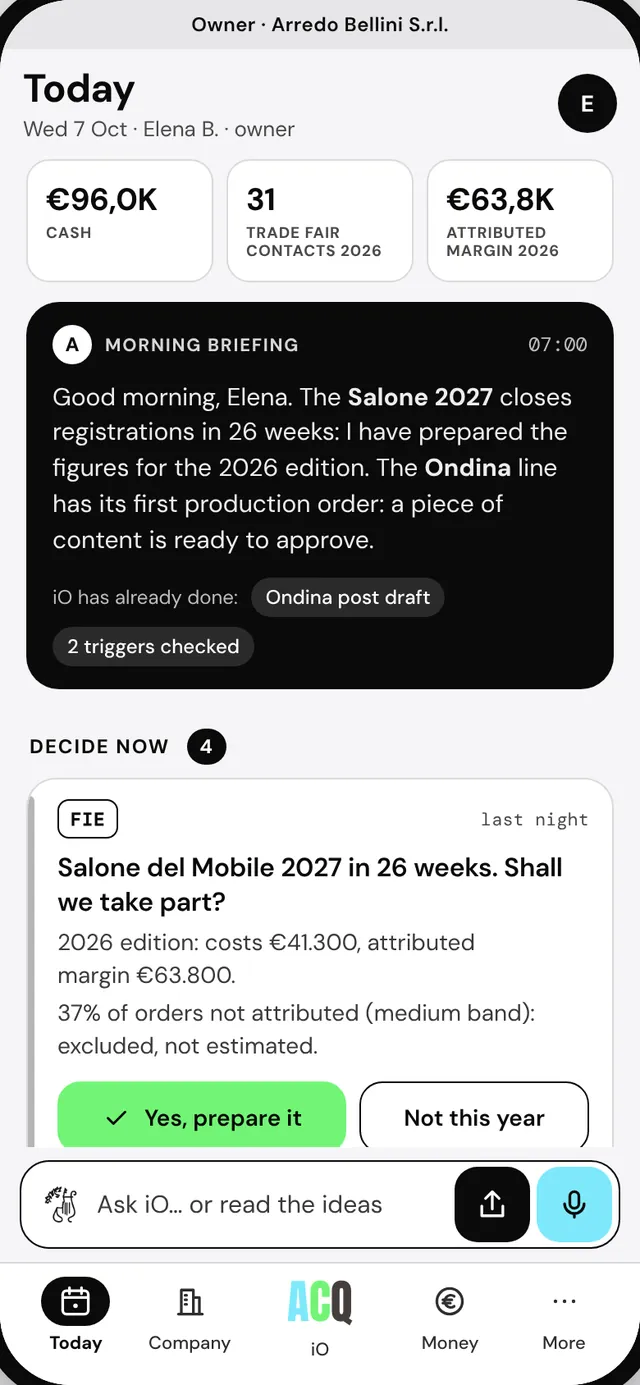
Elena B. · owner of Arredo BelliniCash, leads from the trade fair, attributed margin. And one decision: the 2027 Salone.
The prototype has fifteen people and six companies. Each one enters with their own lens; in More they find “Switch persona”.
Journey 3 · a group of six companies
Many businesses in one app.
Fine-grained management, fine-grained view.
Holding company, subsidiaries and associates live in the same app, each with its own scheme and its own data. You switch from one company to another with a strip at the top: it's a change of context, not a filter.
The same app used to watch the group and do business intelligence is the one that, in the other departments, different people use for their job: administration, purchasing, production, warehouse, sales. The numbers management reads are the ones the departments write while working: there's no second system to keep in line.
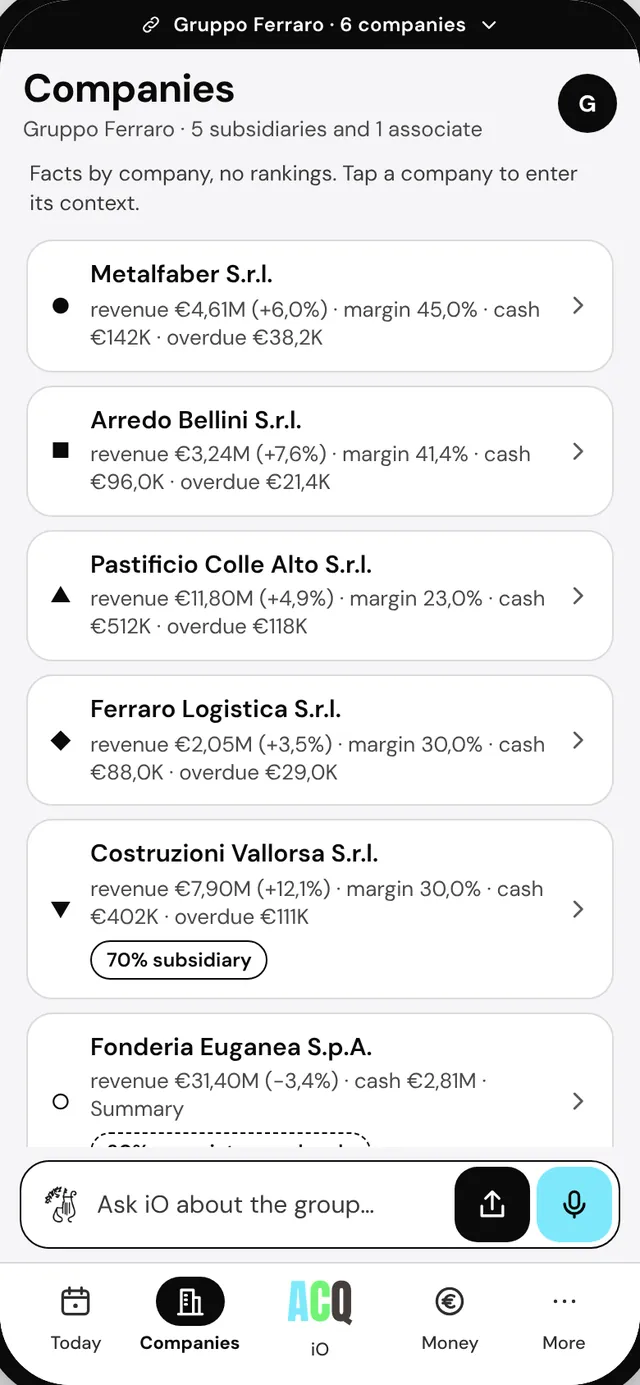
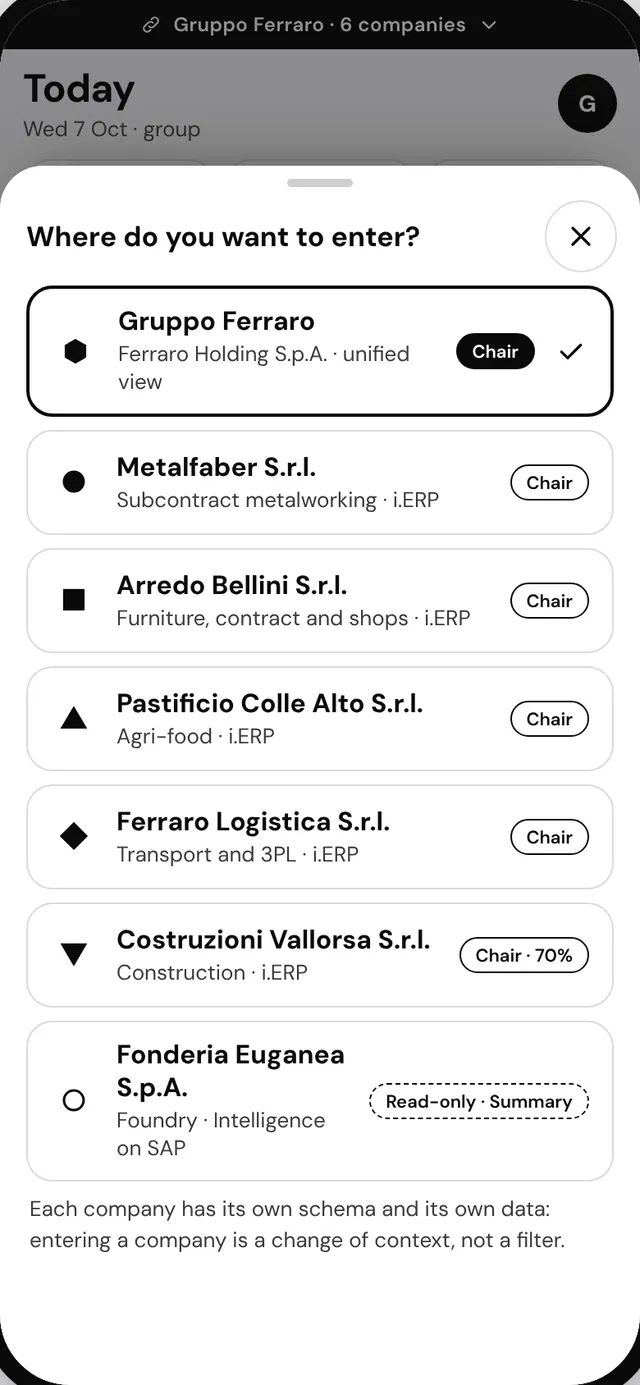
One account, several companies.
Not one login per company: a single access, with the companies where you have a role. A company that stays on its own management software can join the group with just the summary.
Permissions by company, department and person.
You can decide in one company and only read in another, manage one department and not the one next door. Changing a permission is an explicit act; in More everyone reads what they see and what they don't.
Each sees at their own scale.
The whole group, one company, one department, down to the single figure. Companies compare on facts, never in a ranking.
The desk
The phone is action.
The desk is analysis and creation.
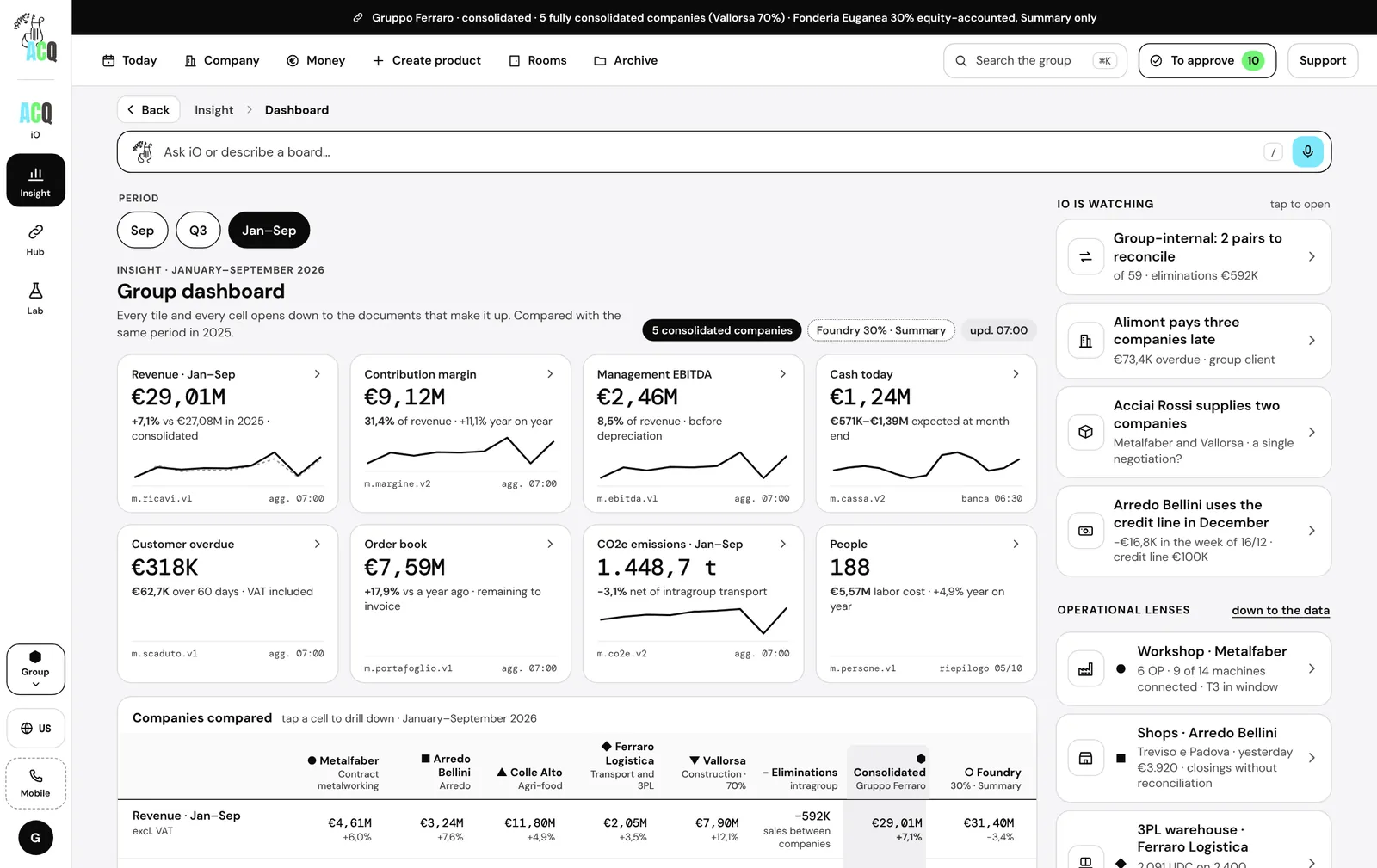
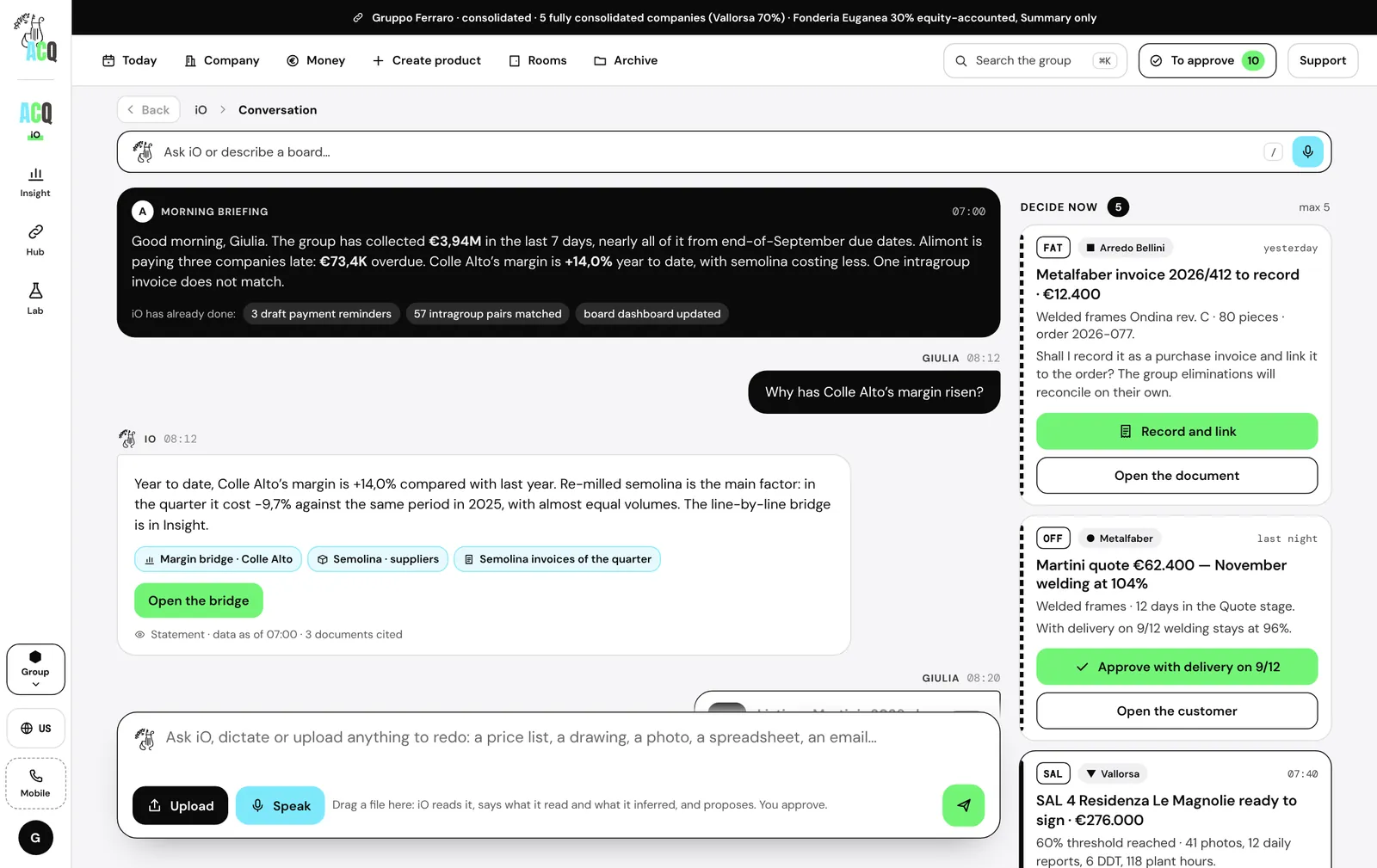
The desk is the desktop version of iERP: the same app and the same data as the phone, for different work. On the phone you act: you record what happens, sign and pay, wherever and whenever it's needed. On the desk you analyse and create: you trace the numbers back to the single document, design products and follow their costs and margins, adapt ACQ to how the company works. That's why the desk doesn't enter data, sign or pay: when something needs doing, it sends you back to the phone.
Create product
A product is born from a sentence.
Or from a sketch, a photo, a product that already exists.
Giulia dictates: “A tall stool for the bar at Hotel Lago Blu, in the same fabric as the Ondina. We need 24, around 320 euros.” iO starts from the Ondina, inherits frame, fabric and the history of its tests, and asks three questions to the people who know. Two minutes later there is a draft: one record, with all its facets.
Create product › Ondina Bar
Create a product
Start however it comes to you: a sentence, a voice note, a sketch, a photo or a product that already exists. iO asks only the questions it needs and prepares a single record.
GGiulia · 11:02
0:14 · voice note
“A tall stool for the bar at Hotel Lago Blu, in the same fabric as the Ondina. We need 24, around 320 euros.”
 iO · 11:02
I’m starting from Ondina rev. C: I inherit the removable backrest, fabric, frame and the history of the tests. I needed three answers: I asked Elena and Bruno.
Seat height 75 cm for a 105 cm counter (Elena B.) · footrest in steel tube, from Metalfaber (Bruno S.) · 24 pieces straight away, then in the catalog (Elena B.).
Product interview · 3 questions · each answer with the name of whoever gave it
iO · 11:04
Here is the draft: a single record with all its faces. Nothing goes on sale without the approval of the manager and the owner, or of the customer.
Describe a product, upload a sketch or start from one that already exists…Draft · Ondina Bar · Arredo Bellini
Tall stool for hotels and bars
45 × 50 × 105 cm · seat at 75 cm · branch of Ondina rev. C
- Bill of materials
- 9 lines · 7 from Ondina, 2 new: tall frame and footrest
- Suppliers
- Metalfaber for frame and footrest (in the group) · Tessuti Brenta for the fabric
- Routings
- cutting and welding → upholstery → covering → final inspection
- Variants
- 6 fabrics from the collection · black or brass frame
- Compliance
- EN 16139 for contract use: test to run · class 1IM fabric already certified
- Estimated cost
- €176–198 each · medium confidence · on 24 pieces
- Proposed price
- €320 · expected margin 38–45%
- IP
- owned by Arredo Bellini · licensed design: Studio Marta Lenzi must say yes
Nothing becomes a product without your confirmation. Patents: in preparation. Tax benefits: only after the professional’s validation.
One record only.
Data sheet, bill of materials, routings, variants, compliance, costs, carbon, intellectual property: facets of the same object. The sheet you edit is the same one in the Lab and in the Hub.
It goes on sale when approval arrives.
The stool enters the price list only with the approval of the manager and the owner, or of the customer when it's made to measure for them. It's not a box to tick: it's the Lab's rule, and it applies to everyone.
Nothing without you.
iO prepares the draft and asks only the questions that are missing; every answer carries the name of the person who gave it. It becomes a product when you confirm.
Lab · research and development
Every project has a story.
And an account.
The Ondina, Arredo Bellini’s contract seat, was born on 14 June from a request by Hotel Cortina. In the Lab its page holds together the creative context — who it’s for, what changes, constraints, materials — and the economic one: budget, spend, declared hours, external costs, expected price and margin. Every line of the cost register has its invoice or its hours.
Lab › Projects › Ondina
Ondina · seat for the contract sector
An upholstered seat assembled in eight facets and repaired on site: the backrest slides off, the fabric is changed without dismantling the frame. Born from Hotel Cortina’s request.
Creative context · Add an idea
- For whom
- Hotel contract · Hotel Cortina, then catalog
- What changes
- Removable backrest · fabric replaceable on site · 8 faces
- Constraints
- Class 1IM · 120 kg · washable · target price €390
- Materials
- Metalfaber frame (Staffa S12) · HR 35 foam · Kvadrat / Sunbrella fabric
- Variants
- Contract · Home · Outdoor (branch)
The story · with who did what
- 14/06Request from Hotel Cortina: 120 seats, fabric to be changed every 3 years
- 28/06Elena’s sketch: removable backrest
- 19/07Prototype 1 · Metalfaber frame rev. A
- 09/08Test 1 passed · 120 kg · 2 non-conformities on the fixing
- 02/09Rev. C · Staffa S12 with 10 mm hole · test 2 passed
- 14/09Series active · first 40 seats · product sheet in the Hub
- todayiO proposes: HR 35 foam also holds up outdoors with Sunbrella fabric · to be confirmed
Economic context · Record a cost
| Cost register | Amount |
|---|---|
| Frames rev. C · 40 piecesMetalfaber (intragroup) · 09/09 | €7.280 |
| Hours Bruno S. · 148 hdeclared · Jun–Sep | €5.920 |
| Hours Elena B. · 41 hdeclared · Jun–Sep | €2.050 |
| Kvadrat fabric · 48 mTessiltex · 30/08 | €1.860 |
| HR 35 foam · 40 seatsPoliuretani Veneti · 28/08 | €1.340 |
| 120 kg test · laboratoryCatas · 09/08 | €920 |
| Every line with its invoice or its hours | €22.870 |
iO proposes · an exchange within the group
The tube offcuts from the DN80 flange (Metalfaber) are the size of the Ondina Outdoor legs: 180 pieces a year, nothing to buy. To be confirmed.
iO proposes · from product to service
Hotel Cortina changes the fabric every 3 years: an on-site re-covering service, on subscription, is worth more than the second sale.
IP and incentives: patents in preparation; R&D credit and patent box not calculated before the professional’s validation.
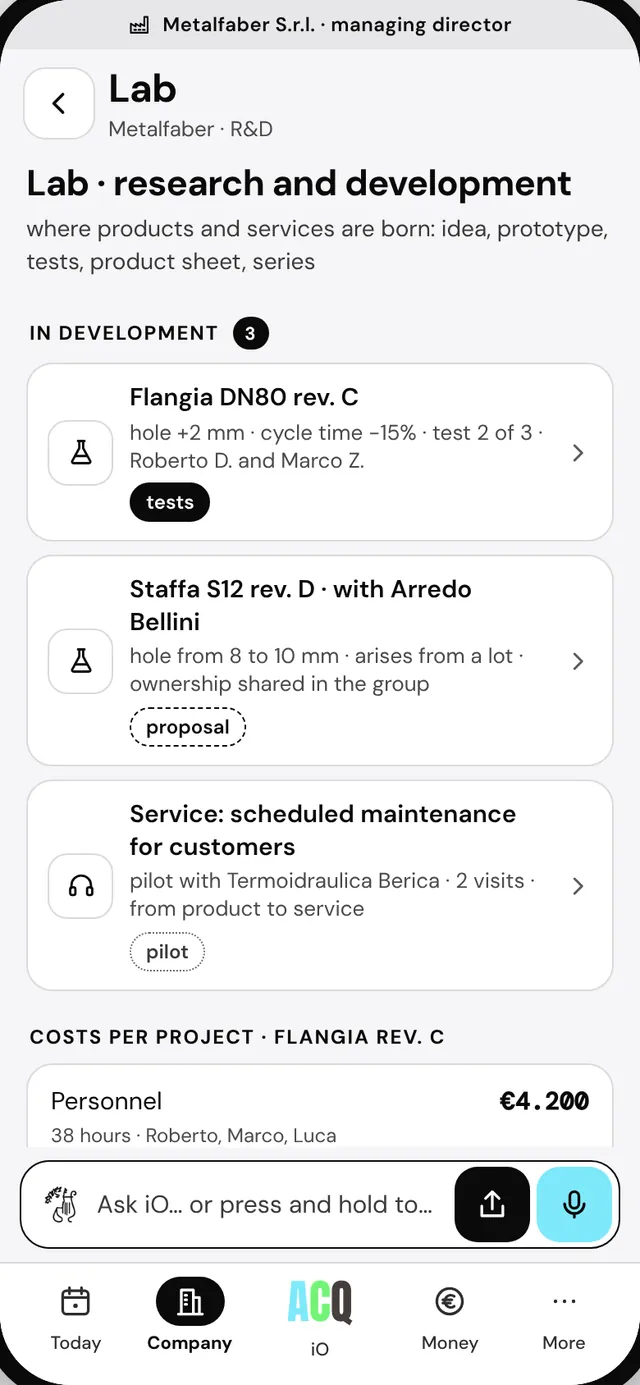
The same Lab, on the phoneAndrea sees Metalfaber’s three projects and the costs per project. This is where you contribute: by voice, with a photo, with a cost.
Contributing is a sentence.
An idea, a photo, a cost, the hours, a question for the supplier: write, speak or upload. iO shows where it puts it and with what effect; you confirm, and it appears in the story and in the register.
Who did what, with certain dates.
Every contribution carries a name and a date. Ownership is declared on the branches; intellectual property is one facet of the project, not its purpose.
No benefits before the professional.
The R&D credit and the patent box are not calculated until the professional validates them. Patents are “in preparation”, and that is what we call them.
Money · per product
How much each product earns.
From real costs, not the price list.
Every product is a single record: you edit it, you work on it, and you see how much it earns and how. The margin is on full cost: materials from consumption, labour from declared hours, machines from measured hours, transport from the routes. Updated at seven, every morning.
Product gallery › Ondina · contract seat
Full cost · per seat
| Channel | Pieces | Revenue | Margin |
|---|---|---|---|
| Resellers · 2 | 36 | €12.672 | 23% |
| Bellini Casa shops | 8 | €2.808 | 29% |
| Contract · Hotel Lago Blu120 seats · delivery 20/11 · not yet invoiced | 120 | — | 31% expected |
Margin on full cost: materials from consumption, labour from declared hours, machines from measured or declared hours, transport from the routes. Every line opens down to the documents.
If you edit the sheet · iO lists what it touches
- Customer orders
- 1 · Hotel Lago Blu, 120 seats, delivery 20/11
- Production
- OP 2026-112 · 40 frames assembled
- Warehouse
- 64 rev. C frames
- Suppliers
- Metalfaber · frame order 2026-084: drawing to republish
- Tests
- is a new test needed? Quality decides
- Cost
- to recalculate on the new bill of materials
DN80 PN16 flange · Metalfaber
Rev. C removes one operation (centring on the lathe): at today’s price the margin would rise by about 6 points.
Bronze-die pasta 500 g · Colle Alto
The factory shop sells 3% of the pieces and brings in 16% of the margin: no intermediaries, no transport.
One record per product: the product sheet you edit here is the same as in the Lab and the Hub.
The margin of every channel.
Resellers, own shops, contract: the same product earns differently. You see it line by line, and every line opens down to the documents.
The cost that changes with the routing.
One operation fewer on the flange is worth about six points of margin. You know it before touching the price list, not at year end.
One change, all its consequences.
You change the frame drawing and iO lists what it touches: the open order, production, the warehouse, the supplier, a test, the cost. You approve, one thing at a time.
Launcher · change ACQ
Not an ERP to learn.
A system for building your own.
ACQ isn't a finished ERP: it's the system a business uses to build its own. From the desk, in Archive, the Launcher changes everything: roles and lenses, look and names, processes and relationships, the data schema, the integrations. You say it, iO shows the difference, you approve. Every change has a version and can be revoked.
Launcher · change ACQOwner
- Roles and lenseswho sees and who approves what · 15 active profiles
- Appearance and namescolors, logo, the vocabulary of the rooms · the site and the app with your brand
- Processes and relationshipsapproval flows, thresholds, who answers to whom · 9 active rules
- Liquid Schemafields, objects, rules, versions · schema v18
- Integrations assisted by iOSAP, banks, SdI, machines, e-commerce · describe or upload, iO proposes the connector
Say it and it appears, here too
“Add the heat number field to batches, with the supplier’s number”
The difference
Who can do it: the owner, or whoever holds the delegation in More › Signature. Nothing changes for anyone else until it is approved.
Your vocabulary, your brand.
The rooms are called what you call them: “sites”, “jobs”, “departments”. Colours and logo are yours, in the app and on the site.
Processes the way you really run them.
Below a threshold Paola approves, above it Andrea; who answers to whom, and how fast. Nine rules, written in plain words, revocable.
Integrations are described, not coded.
SAP, the bank, the e-invoicing exchange, press P2, an online shop: describe it or upload a document, iO proposes the connector and tries it on one record before switching it on.
The desk reads, it doesn't enter data. It doesn't sign and it doesn't pay. When it's your turn, it hands you the phone: that's where your identity is, and that's where every responsibility passes.
Phone and desk together
Whoever handles things works with their hands full.
Goods receipts, picks and counts go through the scan on the phone; the gate and the line report by themselves. The desk reads what the hands have done.
Signatures and payments, only on the phone.
Digital identity, electronic ID card or your fingerprint. On the desk you find “Sign on your phone”, and the signature goes into the register.
Same objects, not the same screens.
A document says the same things, in the same words, on both screens. The desk shows more lines; the phone shows the signature.
Connections
It connects to everything.
From the warehouse to the web.
The tools you already have stay where they are: the rugged terminal in the warehouse, the barcode reader at the counter, the scale, the label printer and the office printer. ACQ connects to each of them and, on the other side, to the web: CRM, online shops, marketplaces. A scan, a weighing or an online order lands in the same place, and nobody copies it.
Rugged terminals
Warehouse smartphones, with the code reader built in. The ACQ app runs there and uses that reader: the code read is already a receipt, a pick, a count.
receipts · picks · stock countsBarcode readers
Gun-style and desktop ones, with cable or Bluetooth. You pair them with the phone, tablet or computer, and the code goes in where it's needed without typing anything.
receiving · production · tillScales
From the counter scale to the weighbridge for lorries. The weight goes into the batch, the label and the delivery note on its own, without passing through a spreadsheet.
weighings · tares · deliveriesLabel and office printers
Thermal printers print labels with the barcode for batches, parcels and shelves; office printers do delivery notes, invoices and pick lists.
thermal labels · A4 · over network or Bluetooth
On the web
CRM, online shops, marketplaces.
Orders from your site and marketplaces come in on their own; stock, prices and shipments flow back updated. The CRM and ACQ talk about the same customers.
- Salesforce
- HubSpot
- Shopify
- WooCommerce
- PrestaShop
- Magento
- Amazon
- SAP
- Banks
- SdI (Italian e-invoicing)
No connector yet? Describe it to iO, which proposes it and tests it on a record before switching it on.
Get in
Take it
in hand.
Fifteen people, six companies, phone and desk, ten languages. Leave your email: the prototype opens straight away and you choose the language. And you're on the list for when we open in your country. One thing, not two.
- Priced per company, not per user
- No set-up fee
- Machine connection included
- Suppliers and customers join free
Where we open, in order
- 1Italy and the United Statesthe launch
- 2Germany, France, Spain, United Kingdomright after
- 3Japan, Korea and Chinathen
The site is in Italian and English; the prototype speaks ten languages. Leave your email today, and we’ll write to you when it’s your country’s turn.
Open the prototype
Your email and the privacy notice are enough. Your company, if you like.